
Introduction
TikTok Shop moves fast, and products can gain traction long before traditional market research catches on. TikTok Shop data scraping helps brands, retailers, agencies, and product researchers collect public data on products, sellers, pricing, sales, reviews, and creators at scale. Instead of manually checking hundreds of listings, teams can organize this information into structured datasets and track how products change over time.
The real value comes from comparing repeated snapshots rather than looking at a single listing. Changes in units sold, review volume, pricing, seller activity, and creator participation can reveal products gaining momentum in the U.S. market.
This blog explains what TikTok Shop product data you can collect, how TikTok Shop scraping works, which signals can indicate emerging trends, and how businesses can use the data for product research and competitive analysis.
What Is TikTok Shop Data Scraping, and Why Does It Matter?
TikTok Shop data scraping is the automated extraction of publicly available information from TikTok Shop product listings, seller pages, and other accessible marketplace pages. Depending on the source and collection method, a dataset can include product titles, categories, prices, discounts, ratings, review counts, sold counts, seller information, availability, variants, and product URLs.
The extracted information can then be cleaned, standardized, deduplicated, and delivered in formats such as CSV, Excel, JSON, or through an API. When collected repeatedly, these datasets can also support price monitoring, seller tracking, catalog analysis, and product trend research.
What TikTok Shop Data Can You Scrape?
TikTok Shop Data | Example Fields | Use Case |
Product data | Product name, URL, ID, category | Catalog research |
Pricing data | Current price, original price, discount | Price monitoring |
Sales data | Units sold, sales rank | Demand analysis |
Review data | Rating, review count | Product validation |
Seller data | Seller name, store URL, store metrics | Competitor analysis |
Inventory data | Availability, stock status | Supply monitoring |
Variant data | Size, color, SKU, option | Product-level analysis |
Creator data | Creator/affiliate information | Influencer research |
Promotion data | Discounts, deals, offers | Promotion monitoring |
Shipping data | Shipping information where publicly displayed | Marketplace comparison |
Why Should You Track Trending TikTok Shop Products Early?
Spotting a trending product on TikTok Shop early, while demand is still building, protects your margins and buys you time to plan. Timing is what separates a confident move from a gamble, and the data makes that timing possible.
- A rising product can reach your shelves before competitors notice the same demand curve, so sourcing gets a real head start.
- Marketing money goes further when it follows proven winners rather than untested hunches.
- Competitor pricing is visible at a glance, which means you can hold your position without slashing margins to do it.
- Inventory risk drops sharply once genuine demand signals show you what will actually sell.
- The right creator partnerships become obvious when the numbers reveal which affiliates and videos drive orders.
How Does TikTok Shop Data Scraping Work?
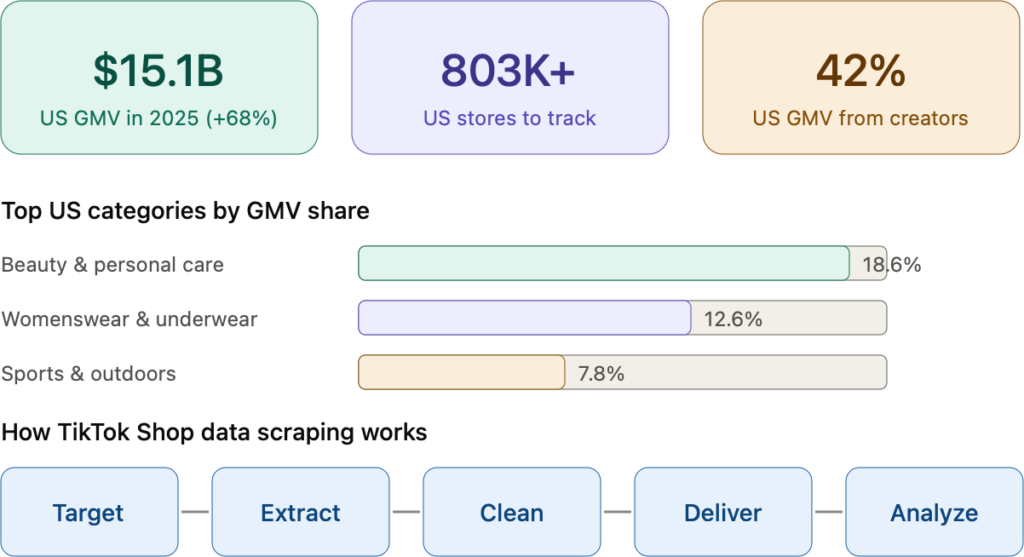
Once you see it laid out, the process is easy to follow. Most reliable TikTok Shop data scraping follows the same five stages, and knowing them makes it easier to judge a vendor or an in-house setup.
- It starts with a clear target. You decide which categories, keywords, or specific stores to focus on, based on what you actually need to learn.
- Automated crawlers then gather the public fields you need: prices, sales counts, reviews, and more.
- The raw output is rarely usable on its own, so a cleaning and structuring stage turns it into tidy rows and columns.
- Delivery is flexible. Depending on your systems, the data can arrive as CSV, JSON, Excel, or a direct API feed.
- Finally, social commerce analytics convert the dataset into rankings, alerts, and forecasts you can act on.
Before we look at the numbers, here is the entire picture in a single view:
What Do the Numbers Say About TikTok Shop USA?
Estimates of U.S. TikTok Shop sales vary by source and methodology. Momentum Works and Tabcut estimated 2025 U.S. GMV at $15.1 billion, up 68% year over year, while eMarketer estimated U.S. TikTok Shop sales at $15.82 billion. Both estimates indicate substantial growth in the U.S. market.
- Over 803,500 stores were active in the U.S. that year, though more than half never made a single sale.
- By category, beauty and personal care led the way, with womenswear and underwear close behind, followed by sports and outdoors.
- Creators do much of the selling here, generating roughly 42% of all US TikTok Shop GMV.
- The trajectory points up. eMarketer expects U.S. sales to pass $20 billion in 2026 and clear $30 billion by 2028.
TikTok Shop Data Scraping vs. Manual Product Research
Factor | Manual Research | Automated Scraping |
Number of products | Limited | Large-scale |
Refresh frequency | Low | Scheduled |
Historical tracking | Difficult | Easy to automate |
Price monitoring | Manual | Automated |
Seller monitoring | Time-consuming | Scalable |
Trend detection | Limited | Data-driven |
Data formatting | Manual | Structured |
Also read: Web Scraping vs Manual Data Collection
Which Early Signals Tell You a Product Is About to Take Off?
Not every rising listing turns into a hit. The real skill is telling a genuine trend apart from noise. A single viral video can lift a product for a day and then let it sink, so one data point rarely justifies a purchase order. What you want is momentum that holds up over time.
A handful of patterns usually separate a real winner from a flash in the pan:
- Repeat velocity is the clearest of them. When units sold climb steadily across several days instead of spiking once, the demand behind it tends to be real.
- Watch how widely creators pick it up, too. A product carried by many small creators often outlasts one riding on a single big name.
- Review pace says a lot as well. Fresh reviews arriving faster than usual mean buyers are converting, not just scrolling past.
- Price is the last thing to check. Sellers who hold their price while volume rises are confident, and that confidence is worth reading as a signal.
These signals become more useful when combined and tracked across multiple observations, but they should be treated as indicators rather than guarantees of future demand.
Who Uses TikTok Shop Data?
This approach is not limited to large enterprises. Teams of every size now rely on social commerce analytics to compete on the same feed. Dropshippers use early signals to test products before committing capital to stock, while established brands monitor competitor catalogs to protect the market share, they’ve built. Agencies turn the raw data into client-ready reports, and investors track category momentum to identify the next breakout niche before it becomes obvious. The common thread across all of them is repeatability. Being able to monitor rival TikTok Shop sellers on a consistent schedule is what separates a lucky guess from a strategy you can defend. That is precisely the kind of pipeline the team at 3i Data Scraping builds around each specific goal.
How Often Should You Collect TikTok Shop Data?
The appropriate refresh interval depends on how quickly the business can respond and how frequently the underlying signals change.
Use Case | Suggested Refresh Approach |
General market research | Weekly |
Competitor pricing | Daily |
Product trend detection | Daily or more frequently |
Major shopping events | Higher frequency |
Historical catalog research | Weekly/monthly |
Fast-moving products | Multiple observations per day |
Legal and Compliance Considerations
A few ground rules protect both your results and your reputation. Start with the legal side. Collect only what’s publicly available, and stay within the platform’s terms of service. Data freshness is nearly as important, because the trending products TikTok Shop buyers want can change within days, and that makes regular refresh cycles essential rather than optional. Quality control completes the list, since clean and deduplicated records are far more useful than a large but disorganized dataset. When these three principles work together, your TikTok Shop product data stays accurate, current, and ready to support confident decisions.
TikTok Shop Scraping: In-House vs. Data Provider
Eventually the question turns practical. Do you build this capability yourself, or bring in a specialist? Both routes work, and the right choice depends on your resources more than anything else.
Building in-house gives you full control. You own the pipeline, you set the priorities, and nothing leaves your walls. The cost is maintenance. TikTok updates its pages often, and a scraper that ran perfectly last month can break overnight, so you’ll need engineers ready to keep it alive.
A partner takes that weight off your team. Specialists handle the upkeep, the proxies, and the awkward edge cases, and you simply receive clean TikTok Shop product data on a schedule you set. For most brands and agencies, that trade makes sense, since it frees your people to act on insights rather than babysit code.
No single answer fits everyone. A large retailer with a deep engineering bench may want to own the whole stack, while a leaner team is usually better off outsourcing. If you’re weighing the two, the team at 3i Data Scraping can walk you through what each path would look like for your goals.
Conclusion
TikTok Shop data scraping can turn a fast-moving marketplace into a structured source of product, pricing, seller, review, and trend data. The most useful insights come from tracking these signals repeatedly rather than relying on a single snapshot. By comparing changes in sales activity, reviews, prices, rankings, creator participation, and availability, businesses can identify products and categories worth investigating further.
The right collection frequency depends on how quickly the market changes and how quickly your team can act on the information. Whether you build the pipeline internally or work with a specialized data provider, clean data, consistent collection, historical tracking, and responsible use are essential for reliable TikTok Shop analysis.
Ready to spot trends before your competitors do? 3i Data Scraping builds TikTok Shop data pipelines around your categories, competitors, and refresh schedule. Contact our team for a sample dataset or a free consultation.
About the Author
3i Data Scraping Editorial Team
At 3i Data Scraping, our Editorial Team shares practical insights on web scraping, data extraction, and AI-powered data solutions. We create content based on industry trends and real-world applications to help businesses leverage web data for market intelligence, competitive analysis, and informed decision-making.