Key Takeaways
- What it is: Audio web scraping collects publicly available or licensed recordings, such as podcasts, webinars, interviews and broadcasts, and turns them into structured datasets. You end up with usable data, not just a folder of audio files.
- Top 6 use cases: Speech recognition datasets, voice assistant training, audio sentiment analysis, podcast market research, media monitoring and brand intelligence, and accessibility and content discovery.
- Most of the work comes after collection: Converting formats, removing noise, cutting recordings into clips, transcribing them and having people check the results is what makes audio usable for AI and analysis.
- The market is large: There are roughly 584 million podcast listeners worldwide, and analysts project 19.1% yearly growth through 2030. Many recordings still haven’t been analyzed.
- Public doesn’t mean free to use: Before collecting anything, check source licenses, platform terms, biometric laws like Illinois BIPA and privacy rules like the CCPA.
- Start with a pilot: Define your goal, approved sources, data fields and quality standards, then test a small sample before scaling up.
Businesses collect customer insights from reviews, social media, and search trends. But valuable information also exists in podcasts, webinars, video reviews, interviews, and online broadcasts. Audio web scraping helps businesses collect these publicly available recordings and turn them into structured datasets for analysis and AI applications.
From building speech recognition models to tracking brand mentions and analyzing customer sentiment, audio data extraction supports several business use cases. However, collecting audio files is only the first step. Businesses also need accurate transcripts, proper labeling, consistent formats, and reliable data collection processes to make the information useful.
As voice-based technologies continue to grow, access to quality audio datasets is becoming increasingly important. This guide explores six practical use cases of audio web scraping, explains how the extraction process works, and covers the technical and legal considerations businesses should understand before starting a project.
What Does Web Scraping Audio Actually Mean?
In simple terms, web scraping audio means using software to find sound files online, Audio web scraping is the process of automatically discovering and collecting audio files or audio streams from permitted online sources. These sources may include podcast RSS feeds, public audio libraries, webinars, interviews, online broadcasts, and video platforms.
Unlike traditional web scraping, which primarily extracts text, images, prices, or product information, audio scraping involves collecting sound files and processing them into usable data. This may include converting speech into text, identifying speakers, adding timestamps, and labeling conversations by topic.
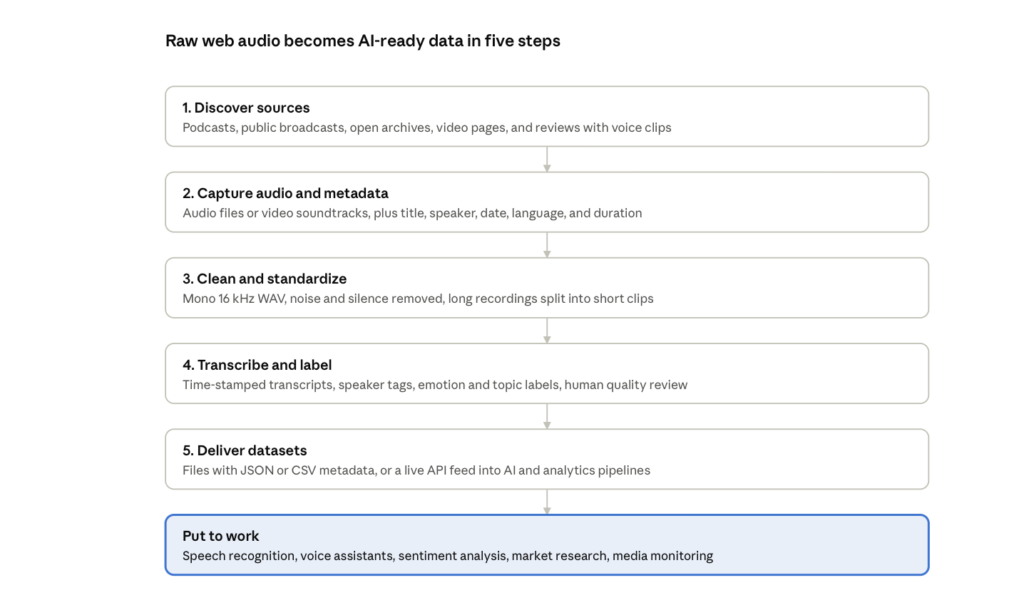
A typical project usually follows this order:
- Discovery, where crawlers find relevant audio on podcasts, broadcasts, archives, and video pages.
- Capture, where files or soundtracks are saved together with details like speaker, date, language, and length.
- Processing, where the audio is converted to one consistent format, cleaned up, and cut into segments.
- Enrichment, where transcripts are generated and people add labels for speakers, topics, or tone.
What you end up with is a dataset rather than a pile of recordings, which is why we treat audio as a full data extraction job and not a bulk download.
Infographic: How Does Web Audio Become AI-Ready Data?
What Are the Top 6 Use Cases of Audio Web Scraping?
Building Speech Recognition Datasets
A speech-to-text engine is only as good as the voices it has heard during training. If it has mostly learned from clear, studio-quality English, it will struggle with a nurse dictating notes in a busy hallway or a customer calling from a car. Open projects help here. Mozilla’s Common Voice release 19.0 held roughly 32,584 hours of speech in 131 languages. Even so, it can’t cover every industry’s vocabulary. That’s where properly licensed web audio comes in, and it’s why many teams use AI training data services to build audio datasets for machine learning that match their own field.
Training Voice Assistants That Sound Less Robotic
Who gets the most out of this? Teams working on in-car assistants, smart speakers, and support bots.
Why does scraped audio help? Real people rarely speak in neat, complete sentences. They trail off, interrupt themselves, and switch topics halfway through a thought. Audio scraping for AI gives these teams hours of that kind of natural conversation from interviews, call-in shows, and panel discussions, so the assistant gets used to how customers really talk.
Audio Sentiment Analysis
A transcript tells you what someone said, while the recording often hints at how they felt about it. Analysts usually look at signals like these:
- Changes in pitch or speaking speed when a product comes up
- Long pauses around topics like pricing
- Sudden volume shifts in video reviews and live streams
- Transcript wording that either matches or clashes with the tone
It’s worth being careful here, because these cues are hints rather than proof of how someone feels. A sigh can mean boredom in one language and relief in another, and a noisy recording can throw the whole reading off, so most teams check these audio cues against text-based sentiment analysis before trusting them.
Market Research Through Podcast Data Scraping
People on podcasts usually talk the way they would over coffee, not the way they write a polished review. Because of that, you often hear what they really think about a product, a price change, or a competitor they switched away from. That audience is large, too: Digital Silk’s roundup of industry figures puts global podcast listeners at roughly 584 million in 2025. Podcast data scraping lets a research team pull those conversations into one place, count how often a brand comes up, and note whether the mention was a complaint, a recommendation, or just a passing comment. Once that’s lined up next to your other online market research, patterns start showing up weeks before they reach survey results or sales reports.
Media Monitoring and Brand Intelligence
A single radio segment or influencer video can shape how people see a brand for weeks, and text-based monitoring tools simply can’t hear it. Collecting spoken mentions with timestamps lets PR teams react quickly and feed those mentions into brand reputation tracking alongside their social and news data.
Accessibility and Content Discovery
Streaming services, publishers, and online course providers transcribe their audio so viewers can use captions, search inside episodes, and find related content. It helps with accessibility, and it also makes very large libraries far easier to browse, which is a growing focus in the OTT and entertainment space.
How Do the Use Cases Compare Side by Side?
Use case | Typical audio sources | Main output | Primary users | Business value |
Speech recognition datasets | Licensed podcasts, lectures, open archives | Labeled clips with transcripts | AI and ML teams | Better accuracy across accents and industries |
Voice assistants | Interviews, call-in shows, panels | Conversational speech samples | Product and R&D teams | More natural voice experiences |
Audio sentiment analysis | Video reviews, live streams, podcasts | Tone signals tied to transcripts | CX and insights teams | Richer view of customer reactions |
Market research | Podcasts, webinars, industry panels | Mention counts and topic trends | Strategy teams | Earlier view of demand shifts |
Media monitoring | Radio, news, influencer videos | Time-stamped brand mentions | PR and brand teams | Faster response to reputation issues |
Accessibility and search | OTT, e-learning, publisher libraries | Captions and searchable transcripts | Media and education companies | Wider reach and easier discovery |
A quick note on the numbers: MarketsandMarkets projects 19.1% yearly growth for this market through 2030 and values the U.S. share at about $3.13 billion in 2025. Keep in mind that these are analyst forecasts. Podcast supply is also smaller than it looks, since only around 10 to 11 percent of the roughly 4.5 million indexed shows still release new episodes.
How Does Audio Data Extraction Work for Machine Learning?
The collection step usually gets the attention, but most of the hard work in audio data extraction for machine learning happens afterward. For a sense of scale, OpenAI says its Whisper model was trained on about 680,000 hours of web audio. Your project will almost certainly be smaller, though the steps stay much the same.
- Reliable crawling. Audio sites often use embedded players, rate limits, and bot checks, so long-running projects need sturdy enterprise web crawling that won’t break halfway through.
- Format conversion. Files come in as MP3, AAC, OGG, or video, and they get converted to whatever the target model expects. Mono 16 kHz WAV is common for speech work, although some models handle higher sample rates.
- Cleanup. Voice activity detection trims dead air, and filtering reduces background music, echo, and crowd noise.
- Segmenting. How long each clip should be depends on the model and the labeling process. Some teams work with clips under 30 seconds, while others prefer longer chunks, and every clip is matched to its transcript.
- Human review. People check transcripts, tag speakers, and throw out bad clips, and this is where careful data cleaning pays off in model accuracy.
- Delivery. The finished data goes out as files with JSON or CSV metadata, or through a web scraping API when updates need to keep flowing.
How to Start an Audio Web Scraping Project: A Step-by-Step Checklist
Starting an audio web scraping project without clearly defined requirements can lead to irrelevant recordings, inconsistent transcripts, and unnecessary processing costs. Before scaling collection, businesses should establish the project’s objectives, source permissions, data requirements, and quality standards.
- The goal: which model, report, or dashboard the audio is meant to support
- Allowed sources: recordings that are licensed, public domain, or cleared for your purpose
- Required fields: speaker, language, length, topic, timestamps, and custom labels
- Labeling approach: automated, human-checked, or a mix of the two
- Quality bar: acceptable word error rate and how much gets spot-checked
- Privacy and retention rules: how identifiers are removed and how long files are kept
- Delivery format: batch files, cloud storage, or an API
- A pilot run: a small sample tested before anything scales up
Example scenario (illustrative only): A telehealth company wants fewer transcription mistakes on medical terms. It begins with 200 hours of licensed lectures and openly licensed health podcasts, asks clinicians to review a sample of transcripts, and fine-tunes its model only once the pilot shows a clear improvement.
Is Audio Web Scraping Legal and Ethical?
There’s no single yes or no answer, because it depends on where the audio comes from, which copyright and privacy laws apply, what the platform’s terms say, and how you plan to use the data. Being publicly available does not make a recording free to copy or use for AI training. Most recordings carry copyright, and in some states a person’s voice can count as biometric data.
Courts are already looking at this. In a September 2026 U.S. filing, AI music company Suno admitted it had obtained YouTube audio for training. That case hasn’t been decided, and the admission alone doesn’t prove anything was unlawful, but it shows how much scrutiny training data now gets.
Before any audio is collected, a review should cover:
- License terms for every source
- Platform rules, including terms of service and robots.txt
- Biometric privacy laws such as Illinois BIPA, which covers voiceprints
- State privacy laws like the CCPA
- Anonymization rules for names and phone numbers in transcripts
- Source records so the training data can be audited later
This isn’t legal advice, so please have qualified counsel review larger projects.
Why Choose 3i Data Scraping for Audio Data Scraping Services?
Collecting and processing audio data at scale requires more than a basic scraping setup. Businesses need a reliable workflow for source discovery, audio collection, format conversion, transcription, data labeling, and quality validation.
3i Data Scraping provides managed data extraction services to help businesses collect and organize online data for their specific project requirements. With experience across 2,500+ projects and 800+ clients, the company brings its data collection expertise to projects involving audio sources and AI-ready datasets.
Depending on the project scope, businesses can explore support for:
- Audio source discovery: Identifying relevant and accessible audio sources.
- Automated data collection: Collecting permitted audio files and associated metadata.
- Audio preprocessing: Preparing recordings for transcription and analysis.
- Data structuring: Organizing transcripts, timestamps, and metadata into usable formats.
- Quality validation: Reviewing collected data for completeness and consistency.
- Scalable delivery: Providing structured datasets through suitable delivery formats and APIs.
Whether you are developing speech recognition models, building conversational AI applications, or conducting audio-based market research, a structured extraction workflow can reduce the effort involved in preparing usable datasets.
Is Now the Right Time to Start Using Audio Data?
For most companies, yes. A lot of useful customer and market insight is still sitting inside recordings that nobody has analyzed. With licensed sources, a solid processing pipeline, and early legal checks, web scraping audio can lead to better speech models, sharper research, and faster brand monitoring. Starting small with a pilot is usually the smartest way in.
To talk through your first project, visit 3i Data Scraping and request a free sample audio dataset built around your goals.
Frequently Asked Questions
1. What sources can audio web scraping collect data from?
Audio web scraping can collect permitted recordings from podcast RSS feeds, public audio libraries, webinars, interviews, online broadcasts, radio segments, and video platforms, along with metadata like speaker, date, language, and length.
2. How is audio web scraping different from traditional web scraping?
Traditional web scraping mostly pulls text, prices, or images. Audio web scraping collects sound files and processes them into usable data through format conversion, noise cleanup, segmentation, transcription, speaker labels, and timestamps.
3. What audio format is best for machine learning datasets?
Mono 16 kHz WAV is common for speech recognition, though some models accept higher sample rates. Scraped MP3, AAC, OGG, or video files are usually converted to the target model’s format, cleaned, and cut into clips matched to transcripts.
4. Can publicly available audio be used to train AI models?
Not automatically. Public availability doesn’t make a recording free for AI training. Most audio is copyrighted, and voiceprints may count as biometric data under laws like Illinois BIPA. Review licenses, platform terms, and privacy rules first.
About the Author
3i Data Scraping Editorial Team
At 3i Data Scraping, our Editorial Team shares practical insights on web scraping, data extraction, and AI-powered data solutions. We create content based on industry trends and real-world applications to help businesses leverage web data for market intelligence, competitive analysis, and informed decision-making.