Key Takeaways
- A scalable company data extraction pipeline is a full system, not just a scraper. It turns raw web pages into clean, usable business data through set stages: source discovery, collection, parsing, cleaning, validation, storage, and delivery.
- Web scraping replaces slow manual research. It automatically gathers company names, industries, locations, contact details, employee size, and website URLs at a scale that manual work can’t match.
- Keep collection separate from processing. A collect → queue → process → validate → store → deliver workflow keeps failures contained, makes troubleshooting easier, and keeps data flowing.
- Use queues and scale each stage on its own. Queues stop a slow stage from holding up the whole pipeline. Collection, processing, validation, and storage can each grow with demand without a full redesign.
- Plan for data quality from the start. A clear data schema, separate raw and processed data layers, and stage-wise validation keep company data accurate, traceable, and ready for analysis.
- Monitoring and automatic retries protect reliability. Tracking failed requests, missing fields, duplicates, and validation errors helps teams catch problems before they affect business reports.
- Adaptive tools handle real-world challenges. Adaptive crawlers, schema mapping, OCR, and automated updates help you deal with changing website layouts, anti-scraping blocks, and unstructured documents.
- The right partner speeds up enterprise-scale extraction. 3i Data Scraping offers custom web scraping, AI-powered data extraction, automated scraping APIs, and flexible data delivery. This gives businesses a steady flow of structured data for competitive intelligence, lead generation, and market research.
Introduction
What if your business could collect, organize, and process hundreds of thousands of companies’ data without spending hours and hours gathering data manually? Whether you are tracking competitors, identifying potential leads, researching new markets, or building a business directory, having access to accurate company data can make a real difference. But as your data requirements grow, can your existing data collection methods keep up?
This is where a scalable company data extraction pipeline using web scraping comes into play. Instead of collecting business information from multiple websites one page at a time, web scraping automates the process and gathers relevant details such as company names, industry types, locations, contact information, employee size, and website URLs. With the right pipeline in place, businesses can collect, validate, clean, and organize large volumes of company data while reducing manual effort.
But how do you build a pipeline that can handle growing data demands without compromising accuracy or performance? What tools, technologies, and processes should you consider? In this blog post, we will take you through the key steps to building a scalable company data extraction pipeline using web scraping, from defining your data requirements to automating extraction, validation, and delivery.
What is a Company Data Extraction Pipeline?
As the name suggests, a company data extraction pipeline is a structured workflow that moves web data from source websites through collection, processing, validation, storage, and delivery. Rather than considering scraping as a one-time data extraction task, a company data extraction pipeline creates repeatable stages for turning raw web pages into clean, consistent, and usable business data.
A basic web scraping API that simplifies data pipeline typically looks like:
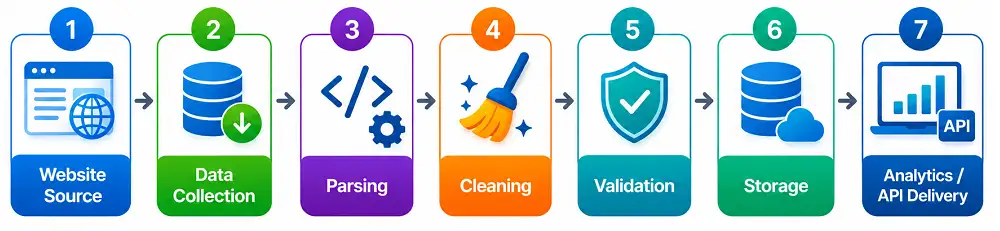
A scalable company data extraction pipeline supports ongoing data collection and processing, rather than one-time scraping.
For instance, a retailer may need to collect:
- Prices
- Discounts
- Product names
- Product availability
- Ratings and reviews
- Product categories
- Seller information
- URLs
- Specifications
The scraper collects the raw information, but the pipeline determines what happens to that information afterward.
That distinction becomes increasingly important as the number of websites, products, categories, and collection schedules increases.
What are the Key Components of a Company Data Extraction Pipeline?
A data extraction pipeline is made up of the following components:
- Data Sources: These are the data sources that include databases, logs, APIs, files, and streams, containing structured, semi-structured, or unstructured data.
- Data Ingestion: Data is collected from various sources and ingested into the pipeline through batch processing, real-time streaming, or both.
- Data Processing: After ingestion, data is cleaned, enriched, and transformed into a suitable format by filtering irrelevant information, aggregating data, and performing necessary computations.
- Transformation: Data transformation converts raw data into a usable format by modifying data types, handling missing values, and creating derived fields.
- Data Storage: Processed data is stored in a suitable destination, such as a data warehouse, data lake, or NoSQL database, based on organizational needs.
- Orchestration: Data pipeline orchestration coordinates data flow across different stages, ensuring each component runs in the correct sequence and at the right time.
- Monitoring & Logging: Regularly monitoring the pipeline to detect issues early, while logging helps track events, debug errors, and optimize performance.
- Error Handling & Retry Mechanisms: Robust data pipelines handle errors through automatic retries, error logging, and administrator alerts.
- Security & Compliance: Ensure data pipelines meet security and compliance standards through data encryption, access controls, and adherence to data protection regulations.
How Does a Company Data Extraction Pipeline Work?
The data extraction pipeline works by splitting the complete data extraction process into multiple stages, with each stage responsible for a specific task, making the workflow easier to scale, monitor, troubleshoot, and modify when source websites or business requirements change.
A standard workflow looks like this:
Source Discovery and Configuration
At the initial stage, the pipeline identifies the websites, pages, categories, products, or other sources that need to be monitored. That includes:
- Target URLs
- Data fields
- Collection frequency
- Geographic requirements
- Pagination rules
- Source specific extraction logic
Data Collection
Next comes the collection layer that retrieves the required source content according to the configured schedule.
Different websites may need different extraction approaches because their structures, page types, and data availability can vary.
Parsing and Extraction
Then that raw source content is converted into individual fields. This is where source-specific extraction logic becomes important.
Data Cleaning
The data extracted generally contains inconsistent formatting, missing values, duplicate records, different currencies, unwanted characters, etc., which are cleaned and presented into a structured format.
Validation
Then comes the data validation pipeline that checks whether the process records meet predefined criteria before they enter the final dataset.
Delivery
At last, the structured dataset is ready to be delivered through JSON, CSV, Excel, or in a customized API format.
This is the stage that makes a company’s data extraction pipeline more manageable at enterprise scale.
How to Build a Scalable Company Data Extraction Pipeline
A scalable data extraction pipeline should be designed around independent processing stages rather than one large scraping application. Collection, processing, validation, and delivery should be capable of scaling independently so that an increase in one workload does not disrupt the entire data operation.
For instance, if product extraction volume increases significantly, the collection layer should be able to handle that additional workload without requiring the entire pipeline to be redesigned.
Distinguish Collection from Processing
A key design principle is to separate data extraction from downstream processing. Rather than handling scraping, cleaning, and storage in a single process, enterprise workflows follow a structured approach: collect-> queue-> process-> validate-> store-> deliver. This separation helps isolate failures, simplify troubleshooting, and improve overall workflow reliability.
Use Queues Between Major Stages
Data analytics for business queues can help prevent one slow component from blocking the entire workflow.
If processing temporarily slows down, collected tasks can wait in the queue instead of being lost or forcing the scraper to stop.
Scale Each Component Separately
A scalable enterprise web scraping data pipeline should support independent scaling of each component based on workload demands. For instance, collection workers can increase as source volume grows, processing workers can expand to handle larger transformation tasks, validation capacity can scale with dataset size, and storage can grow as historical data accumulates. This approach offers greater flexibility and efficiency than simply expanding a single application to handle increased workloads.
What are the Best Practices for Scaling a Company Data Extraction Pipeline?
The best practices for scaling a company data extraction pipeline focus on reliability, data quality, scalability, monitoring, and long-term maintainability rather than just increasing extraction capacity. A well-designed enterprise pipeline should support automated data extraction, handle growing data volumes, recover from failures, maintain data accuracy, preserve historical records, and provide clear visibility into every stage of the extraction and processing workflow.
Define a Clear Data Schema
Before building the web data extraction pipeline, define what the final dataset should contain.
A scalable company data extraction for a clearly defined schema makes validation and downstream analysis much easier.
Maintain Separate Raw and Processed Data
Retaining the original extracted data helps troubleshoot extraction issues and rebuild processed datasets when needed. A practical approach is to organize data into distinct stages: Raw layer → cleaned layer → validated layer → analytics layer.
This structured separation improves data traceability and makes it easier to track changes across the pipeline.
Implement Monitoring from Day One
A pipeline should monitor more than whether a scraper is running. Useful metrics include:
- Source-level changes
- Pages successfully processed
- Failed requests
- Data volume
- Missing fields
- Processing time
- Duplicate records
- Validation failures
This helps teams identify problems before they affect business reporting.
Design for Automatic Retries and Recovery
Web data collection is not always perfectly predictable. Network failures, source changes, temporary errors, and processing failures can occur. A reliable web scraping infrastructure should therefore support controlled retries and failure handling instead of assuming every job will complete successfully.
What are the Common Challenges in Company Data Extraction and How to Overcome Them?
When extracting company data, the web scraping infrastructure goes through a lot of challenges, such as:
Accuracy and Data Quality Problems at Scale
Errors can multiply across thousands of records due to poor scans, unclear handwriting, inconsistent templates, or incorrect categorization, leading to compliance and audit risks.
Solution: Implement stage-wise data validation, confidence scoring, and human review to detect errors early and maintain accuracy. According to reports, advanced document-processing systems can reduce manual errors by 52% and achieve up to 99% accuracy, depending on document quality and validation methods.
Managing Unstructured Documents and Changing Formats
Industries like healthcare, medtech, etc., handle diverse documents, including medical forms, lab reports, prescriptions, contracts, and scanned records. Extraction becomes challenging when layouts and formats vary.
Solution: Modern data scrapers use OCR, ICR, and document classification to convert unstructured content into structured data with consistent validation.
Web Data Extraction Problems in E-Commerce and Retail
Retail and e-commerce rely on real-time website data for product catalogs, pricing, and reviews. However, changing layouts, anti-scraping blocks, and sudden data spikes can disrupt extraction.
Solution: Adaptive crawlers, schema mapping, automated updates, and data validation help ensure reliable extraction while meeting compliance requirements.
How 3i Data Scraping Supports a Scalable Data Extraction Pipeline
3i Data Scraping supports scalable data extraction pipeline requirements through custom web scraping, AI-powered data extraction, API integration, and structured data delivery solutions. Its services help businesses collect and organize web data for competitive intelligence, pricing analysis, market research, product intelligence, and other data-driven applications.
Depending on business requirements, the workflow includes:
- AI-powered data extraction
- Automated web scraping APIs
- Recurring data collection
- Enterprise web data collection
- Custom data extraction solutions
- Flexible data delivery
- Industry-specific data intelligence
For businesses managing growing data requirements, 3i Data Scraping helps establish a consistent flow of structured web data from online sources to business applications, supporting research, analytics, and informed decision-making.
Conclusion
A scalable data extraction pipeline is not just a cluster of scrapers running at a larger scale. It is an end-to-end system that manages collection, processing, validation, storage, monitoring, and delivery as separate but connected stages.
For enterprise use, the best way is to design the architecture around reliability, data quality, independent scalability, historical tracking, and downstream usability. Once established, these foundations make pipeline expansion more manageable.
Frequently Asked Questions (FAQs)
1. What is a company data extraction pipeline?
A company data extraction pipeline is a structured workflow that uses web scraping to collect, parse, clean, validate, store, and deliver business data, turning raw web pages into accurate, consistent, and ready-to-use company datasets.
2. How do you build a scalable data extraction pipeline using web scraping?
Design independent stages for collection, processing, validation, and storage, and connect them with queues. Each stage can then scale on its own, so rising data volumes never slow down or break the entire extraction pipeline.
3. What company data can be extracted using web scraping?
A pipeline can extract company names, industries, locations, contact details, employee size, and website URLs, and deliver the structured data in JSON, CSV, Excel, or API formats for lead generation and market research.
4. How can 3i Data Scraping help build a scalable company data extraction pipeline?
3i Data Scraping builds custom, scalable pipelines with AI-powered data extraction, automated scraping APIs, recurring data collection, and flexible delivery, giving businesses a steady flow of clean, structured company data.
About the Author
3i Data Scraping Editorial Team
At 3i Data Scraping, our Editorial Team shares practical insights on web scraping, data extraction, and AI-powered data solutions. We create content based on industry trends and real-world applications to help businesses leverage web data for market intelligence, competitive analysis, and informed decision-making.