Managing e-commerce data across multiple retailers, marketplaces, and product categories becomes increasingly difficult as a business grows. Prices change frequently, product catalogs expand, and inventory updates happen across different platforms. Relying on manual tracking or generic scraping tools can make it harder to collect accurate, consistent data at the scale enterprise teams need.
Custom e-commerce data extraction solutions help businesses overcome these challenges by collecting, processing, and delivering product information based on their specific requirements. They can support competitor price monitoring, product catalog analysis, inventory tracking, marketplace research, and other data-driven operations.
But implementing an enterprise-grade extraction system involves more than collecting information from websites. Businesses must consider source coverage, data quality, infrastructure, integrations, scalability, and compliance.
This guide explains how custom e-commerce data extraction works, the technologies behind it, and the steps involved in implementation. It also covers practical use cases, project timelines, performance metrics, and important considerations for choosing an enterprise data extraction partner.
What Are Custom E-commerce Data Extraction Solutions?
Custom e-commerce data extraction solutions are purpose-built systems that collect product, pricing, and customer data from chosen websites and apps, then clean, structure, and deliver it on a set schedule. Unlike off-the-shelf scrapers, they are engineered around a company’s specific sources, data fields, volume, and integration needs.
The design is where the real difference sits. A retail enterprise might monitor pricing across two hundred competitor domains, while a marketplace brand may only need review sentiment from the listings it already owns. Both cases follow the same flow, where raw and unstructured pages go in, and clean, analysis-ready records come out through an API or cloud bucket. Most programs bundle web scraping services, data cleaning, and automated delivery, so the feed never goes stale and your analysts never open a raw file. For teams that depend on accuracy at scale, that level of control is why enterprise data extraction beats one-size-fits-all software.
What Do Market Trends Reveal About Enterprise E-commerce Data Extraction?
The growing use of web data across retail, analytics, and artificial intelligence has increased the demand for reliable extraction infrastructure. Enterprise businesses are no longer collecting product information only for occasional competitor checks. They increasingly need structured, frequently refreshed datasets that support pricing decisions, assortment planning, inventory analysis, and business intelligence.
Several industry reports highlight the broader growth of web scraping and automated data collection. However, market size, adoption rates, and AI-related usage measure different aspects of this trend. They should be evaluated separately rather than treated as direct measures of e-commerce extraction demand.
For enterprise retailers, the practical takeaway is clear: data collection infrastructure must support larger volumes, consistent updates, reliable integrations, and ongoing quality checks.
Read also: Managed Web Data Feeds for E-Commerce
Why Do Enterprises Outgrow Ready-Made Scraping Tools?
Point-and-click scrapers are a sensible first step for small jobs, yet enterprise requirements tend to break them quickly. The friction almost always lands in the same few places, and spotting it early saves both budget and months of rework.
- Scale ceilings. Most off-the-shelf tools cap pages or requests, which stalls large-scale product data extraction once you reach millions of listings.
- Fragile templates. A minor layout change on a target site can quietly break a rigid scraper for days before anyone notices the gap in the data.
- Compliance blind spots. Enterprises need documented, lawful collection practices, and consumer-grade tools rarely address terms of service, copyright, or privacy at all.
- Unclean output. Raw exports carry duplicates, missing fields, and formatting noise, so analysts lose hours before any real work begins.
- Thin support. When a mission-critical feed fails at midnight, a self-serve product almost never offers a human who can fix it under an SLA.
How Do Custom Solutions Compare with Off-the-Shelf Tools?
The gap between a generic scraper and a managed enterprise program shows up most clearly side by side. The table below breaks down the factors that start to matter once your needs move past a few thousand records.
Factor | Off-the-Shelf Tools | Custom Enterprise Solutions |
Data volume | Limited by plan caps | Millions of records, built to scale |
Site coverage | Common, simple pages | Complex, JavaScript-heavy, app-based sources |
Data quality | Raw, needs manual cleanup | Validated, deduplicated, analysis-ready |
Maintenance | Your team fixes breakages | Provider monitors and repairs feeds |
Compliance | Mostly your responsibility | Documented, governed collection practices |
Support | Tickets or forums | Dedicated engineers and SLAs |
Cost model | Low upfront, hidden limits | Planned investment, predictable ROI |
What Technology Powers Enterprise-Grade Data Extraction?
Enterprise extraction relies on five technical pillars working together: proxy management, JavaScript rendering, API integration, data normalization, and continuous monitoring. Each pillar solves a problem that breaks smaller scrapers once volume and site complexity rise.
Proxy Management
Large sites watch for unusual traffic, so request patterns have to look natural. A strong setup rotates through pools of residential and data-center IP addresses, spreads requests across regions for accurate local pricing, and throttles the rate so collection stays stable and polite. Geo-targeting matters here, because a product page in Germany can show a different price and currency than the same page in the United States.
JavaScript Rendering
Many modern storefronts load prices and stock through client-side scripts, which means the data is not in the raw HTML. Headless browsers such as Playwright or Puppeteer render the page first, exactly as a shopper’s browser would, and only then is the content extracted. Lighter, server-rendered pages skip this step and use direct HTTP requests with HTML parsing, which is far faster and cheaper at scale.
API Integration and Delivery
The feed has to land where your systems can use it. Common delivery routes include a REST API, scheduled dumps to cloud storage like Amazon S3 or Google Cloud Storage, and webhooks that push updates as they happen. Where a site offers an official API, a good provider ingests that too, since sanctioned endpoints are more stable than page scraping.
Data Normalization
Different sources label the same thing in different ways, so normalization maps every field into one unified schema. The work covers currency and unit standardization, duplicate removal, and product matching across sites through identifiers such as GTIN, UPC, or MPN. Clean matching is what lets you compare the same SKU across ten retailers with confidence.
Monitoring and Quality Control
Websites change without notice, so monitoring never stops. Automated checks watch for schema drift, sudden drops in record counts, and accuracy slippage, then trigger alerts and retries before a broken feed reaches your dashboards. This is the layer that separates a weekend script from a production pipeline.
Which E-commerce Data Points Deliver the Most Value?
The value of e-commerce data depends on the business decisions it supports. An enterprise retailer may prioritize competitor prices and inventory, while a marketplace seller may focus on product visibility, customer reviews, and seller performance.
The following data categories support some of the most common enterprise retail use cases.
Product pricing and discounts
Collecting regular prices, promotional prices, shipping charges, and regional pricing helps businesses compare competitor offers and evaluate pricing strategies.
Product catalog information
Product titles, descriptions, specifications, categories, images, and identifiers help retailers analyze assortment coverage and identify gaps in their catalogs.
Inventory and availability
Stock status, availability indicators, and product restocking patterns provide useful insights for inventory planning and competitor monitoring.
Customer reviews and ratings
Review content, average ratings, and review volumes help businesses understand customer feedback, identify recurring product complaints, and monitor changes in product perception.
Seller and brand information
Seller names, brand details, marketplace listings, and product identifiers help businesses evaluate seller activity, brand representation, and product distribution.
Promotions and offers
Discount percentages, coupon information, bundle offers, and seasonal promotions help retailers understand competitor campaigns and evaluate promotional performance.
How Does a Custom Implementation Work, Step by Step?
A strong rollout rarely happens by chance, and experienced providers follow a repeatable method with clear deliverables at every stage. Most enterprise projects move through five phases, shown below with typical timelines and the metric that proves each phase succeeded.
Phase | Key Deliverable | Typical Timeline | Success Metric |
Discovery | Source list, field schema, volume plan | 1–2 weeks | Signed-off data specification |
Architecture | Proxy, scheduling, and storage design | 1 week | Approved technical blueprint |
Development | Working extractors with anti-blocking | 2–4 weeks | 95%+ successful request rate |
Validation | QA checks and accuracy testing | 1–2 weeks | 98%+ field accuracy |
Delivery & Monitoring | Live feed via API or cloud, with alerts | Ongoing | 99%+ feed uptime |
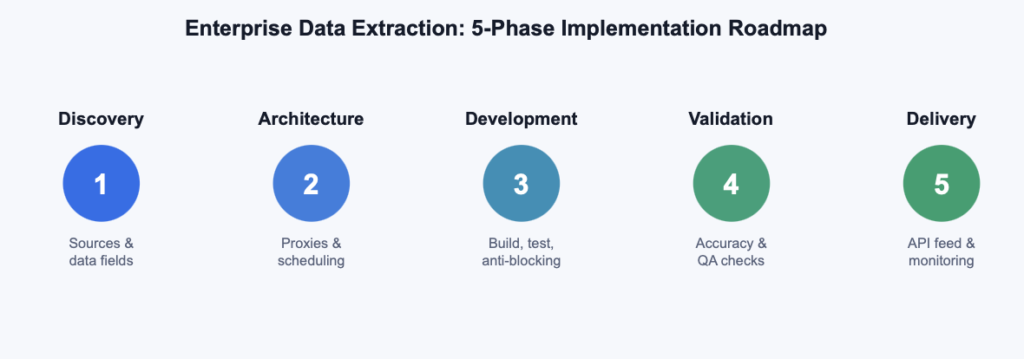
The timelines above are planning ranges rather than promises, since the real number depends on how many sites you track and how complex they are. A single-marketplace project can go live in under a month, while a program spanning dozens of international domains takes longer to validate properly.
What Does a Real Enterprise Rollout Look Like?
The phases are easier to picture through a representative example. Imagine a mid-size electronics retailer that wants daily pricing and stock data from twenty-five competitor sites across three countries, covering roughly 400,000 SKUs.
- During discovery, the team locks the fields that matter, which here are price, shipping cost, stock status, seller name, and rating, all due before 7 a.m. each day.
- Architecture comes next. The build assigns residential proxies country by country and schedules crawls for quiet, off-peak hours. Output then flows to a cloud bucket, with a REST endpoint available on top of it.
- Development handles the extractors. Four of the sites lean on JavaScript, so those need headless browsers, while the simpler pages run on faster HTTP requests. Retry logic sits underneath, catching any page that happens to time out.
- Validation matches SKUs across sources using UPC codes, and a sample gets checked against the live pages until accuracy clears the agreed line.
- Delivery wires the feed into the retailer’s pricing tool, so buyers open their dashboard to fresh competitor moves instead of hunting for them.
The figures here are illustrative rather than a specific client record, but they reflect how a typical engagement is scoped and delivered. For documented outcomes, the 3i Data Scraping case studies page is the place to look.
Is Enterprise Web Scraping Legal and Compliant?
Enterprise web scraping requires careful consideration of website policies, intellectual property rights, privacy regulations, and applicable access restrictions. The fact that information is publicly accessible does not automatically mean it can be collected, stored, or reused without limitations.
Before starting a data extraction project, businesses should evaluate the following considerations.
- Website terms and access policies: Review the target website’s terms of service, published API policies, and applicable restrictions before designing automated collection workflows.
- Copyright and intellectual property: Product descriptions, images, reviews, and other creative content may be protected by intellectual property laws. Businesses should assess whether their intended collection and subsequent use are permitted.
- Privacy and personal information: Avoid collecting personal information unless there is a clearly established legal basis and appropriate safeguards. Applicable requirements may include the GDPR in Europe and relevant provisions of California privacy laws.
- Robots.txt and technical restrictions: Review published crawling instructions and implement responsible request rates. Robots.txt is an important operational signal, although it does not independently determine legal permission.
- Data storage and retention: Establish policies for access control, retention periods, deletion, and the permitted use of collected information.
Enterprise teams should involve qualified legal professionals when evaluating target sources and intended data uses. Compliance requirements vary by jurisdiction, website, data category, and business purpose. This information is general guidance, not legal advice.
How Does 3i Data Scraping Handle Enterprise Projects?
For organizations that would rather not build and maintain this stack in-house, 3i Data Scraping runs the full pipeline as a managed service. The approach is built around a few commitments that enterprise buyers tend to care about most.
- Custom scoping, where the field schema, sources, and delivery format are shaped to your exact use case rather than a fixed template.
- Quality assurance, with validation and data cleaning built into every feed so records arrive analysis-ready.
- Flexible delivery means the data can arrive through a web scraping API, land in cloud storage, or drop straight into your database, whichever suits your stack.
- Ongoing maintenance stays on the provider’s side. If a target site gets redesigned, repairing the broken extractor is their job, and your morning report never shows the gap.
What you end up with is a steady data layer for e-commerce data scraping and pricing intelligence, one your teams can lean on without babysitting a single crawler.
Conclusion: Build a Reliable E-commerce Data Extraction Pipeline
Enterprise e-commerce data extraction is about more than collecting product information from multiple websites. Businesses need accurate records, consistent updates, scalable infrastructure, and reliable integrations to turn raw web data into useful business intelligence.
A well-planned custom extraction solution helps retailers monitor competitor pricing, analyze product catalogs, track inventory, and make informed decisions using structured data. However, successful implementation depends on choosing the right sources, defining data requirements, maintaining quality, and accounting for compliance from the beginning.
If your organization is planning an enterprise data extraction project, 3i Data Scraping can help evaluate your requirements and build an extraction solution around your business needs.
About the Author
3i Data Scraping Editorial Team
At 3i Data Scraping, our Editorial Team shares practical insights on web scraping, data extraction, and AI-powered data solutions. We create content based on industry trends and real-world applications to help businesses leverage web data for market intelligence, competitive analysis, and informed decision-making.