Choosing between a hotel rate shopper and custom scraping affects more than your software budget. It determines how much you spend on competitor rate monitoring, how quickly you receive pricing updates, and how much technical maintenance your team must handle. Hotel rate shopping software typically offers predictable subscription costs, while custom scraping provides greater control over data collection but adds development, infrastructure, and maintenance expenses.
In this guide, we compare hotel rate shopper platforms, in-house scraping, and managed web scraping services across setup costs, annual expenses, data accuracy, scalability, and ongoing support. You will also learn which option suits independent hotels, multi-property groups, and businesses with specialized data requirements. Because actual pricing depends on the number of competitors, booking channels, and update frequency, we use indicative cost estimates to explain the trade-offs and help you choose an approach that fits your budget.
What Is a Hotel Rate Shopper, and How Does It Work?
A hotel rate shopper is a pricing intelligence tool that collects and compares competitor room rates across online travel agencies (OTAs) and hotel websites. It helps revenue managers monitor rate changes, identify pricing gaps, and make informed adjustments without manually checking each booking channel. Depending on the provider and subscription plan, features may include scheduled rate updates, rate parity monitoring, alerts, and integrations with revenue management systems (RMSs).
What Does Custom Scraping Actually Involve?
Custom hotel price scraping involves building or commissioning a data collection system tailored to specific competitors, booking channels, room types, and pricing fields. Depending on the implementation, the system may include crawlers, scheduling, proxy infrastructure, data storage, validation, and monitoring. Although this approach provides greater control over data coverage and collection frequency, the business must account for development, maintenance, and website changes.
Most OTA data scraping setups end up with four moving parts, give or take:
- Target sites, usually a mix of Booking.com, Expedia, Agoda, and the direct pages of whichever competitors you care about.
- The crawler itself, which is really just a script doing the tedious work of reading room rates, availability, taxes, and the odd promo code.
- Proxy networks plus some bot-handling logic, without which the booking sites will flag your traffic and shut the door fast.
- Storage, scheduling, and alerts, the quiet plumbing that keeps your hotel pricing data current instead of letting it go stale.
How Accurate Is the Hotel Pricing Data You Collect?
Hotel pricing accuracy depends on how consistently the system captures, validates, and compares rates. A hotel rate shopper may provide standardized data out of the box, while a custom scraping pipeline can be configured to meet specific data requirements. Neither approach guarantees accuracy without appropriate quality checks.
Accuracy tends to slip in a few predictable places:
- Rate match rate against manually verified booking results.
- Completeness of room type, occupancy, taxes, and cancellation fields.
- Freshness of data relative to the requested collection time.
- Percentage of failed requests and missing competitor records.
Clean rate shopping data is the foundation under every confident pricing decision.
Hotel Rate Shopper vs Custom Scraping: The Cost Breakdown
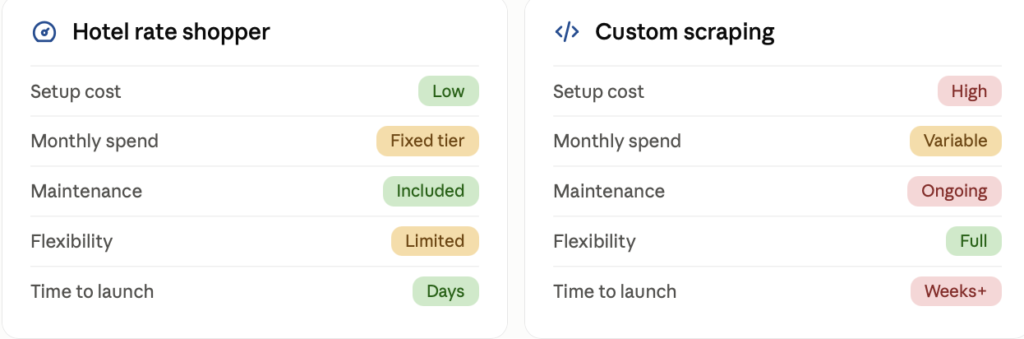
Cost is rarely one number. It spreads across setup, staffing, upkeep, and the time it takes to go live. The table below lines up both options across the factors that matter most to a hotel budget.
Cost Factor | Hotel Rate Shopper (SaaS) | Custom Scraping (In-House) |
Upfront setup | Low — sign up and onboard | High — build crawlers and infrastructure |
Monthly cost | Predictable tier, often ~500+ per property | Variable; proxies, servers, and developer time |
Staffing needs | Minimal; the vendor runs it | Developers plus a maintenance team |
Maintenance | Included in the subscription | Ongoing; crawlers break when sites change |
Data control | Vendor-defined fields | Fully customizable |
Time to launch | Days | Weeks to months |
Scalability | Add properties through your plan | More servers and more engineering |
Best fit | Speed and simplicity | Large-scale, highly custom data |
The pattern is clear enough. A rate shopper trades flexibility for predictable monthly spend, while custom scraping trades convenience for deep control and a heavier upkeep bill.
What Does a Year Actually Cost? A Worked Example
Numbers land harder than adjectives, so here is a simple 12-month model. The scenario is one mid-size independent hotel tracking about 10 competitors across three OTAs, refreshed twice a day.
12-month cost line | Rate shopper (SaaS) | In-house custom scraping | Managed scraping service |
Build / setup (one-time) | $0 – $500 | $8,000 – $15,000 | Included in scope |
Subscription / service fee | $2,400 – $6,000 | — | Quoted by scope |
Proxies and servers | Included | $1,800 – $8,400 | Included |
Maintenance and fixes | Included | $3,000 – $10,000 | Included |
Staff oversight | Low | Medium to high | Low |
Indicative yearly total | ~$2,400 – $6,000 | ~$12,800 – $33,400 | Varies by targets |
These are planning estimates, not quotes. The totals shift with your competitor count, refresh speed, and the number of OTAs in scope. Still, the lesson holds: a homegrown crawler often looks cheap right up until proxies, servers, and developer upkeep get added to the bill.
What Drives the Price Up or Down?
Four levers decide where you actually land in the ranges above:
- Property and competitor count, since every extra hotel you track adds crawl volume and more dashboard seats.
- Refresh frequency, where near-real-time pulls cost far more than a calm twice-daily snapshot.
- Data coverage, as room types, taxes, length-of-stay, and parity checks each add fields someone has to maintain.
- OTA spread, because more sites mean more layouts to handle and more breakage to chase down.
A small property watching a handful of rivals twice a day sits at the cheap end. A group tracking hundreds of competitors by the hour sits at the expensive end, whichever method it picks.
Infographic: Where Does Your Money Go?
The comparison below sums up the cost story at a glance, so you can share it with your revenue team in one screen.
Which Hidden Costs Should You Watch For?
The advertised subscription or development fee does not always represent the full cost of hotel rate monitoring. A realistic comparison should include the time spent managing the system, fixing collection failures, validating data, and adapting to new requirements. For custom scraping, these costs can vary substantially with site complexity and the amount of engineering support required.
- Developer salaries tied to building, testing, and babysitting crawlers’ month after month.
- Proxy and server bills that climb as your crawl volume and property count rise.
- Rework hours whenever an OTA quietly changes its layout and the scraper falls over.
- Subscription creep on the SaaS side, since extra markets, competitors, or seats usually cost more.
- Opportunity cost, as staff time spent gathering data is time not spent setting smarter prices.
Managed providers back this up. One hotel chain reported cost savings of roughly 23% by outsourcing its crawls, and a separate booking-portal project landed near 37% versus staffing an in-house team (reported in PromptCloud’s own case studies). The takeaway is simple: the cheapest option on paper is not always the cheapest once upkeep is counted.
Is Custom Scraping Legal for Hotels?
Hotel rate collection requires a review of applicable laws, website terms, access restrictions, and the methods used to retrieve data. The fact that a price is publicly visible does not, by itself, establish permission to collect it through every method. Hotels should assess the requirements that apply to their jurisdictions and target websites before launching a data collection project.
A few principles keep OTA data scraping on safer ground:
- Public pricing fields only, never private or personal customer details.
- Reasonable crawl rates that don’t hammer or overload any single website.
- Clear records of what you collect and the business reason behind it.
- Legal review for your region before a large-scale project goes live.
A trusted vendor or a managed scraping partner usually builds these safeguards in by default, which is one more reason many buyers lean on specialists instead of going it alone.
Which Option Fits Your Hotel?
There is no single winner here, only the right match for your size, skills, and goals. Use these short scenarios as a shortcut:
- If your property is small or independent and you need answers this week, a rate shopper is usually the smarter call. The predictable fee and zero maintenance suit a lean team.
- If you run a group, a chain, or a travel-tech product and you need unusual data points at scale, custom scraping earns its keep. The control pays off once volume climbs.
- If you want custom data without an in-house engineering burden, a managed middle path tends to win. A provider builds and runs the crawlers while you keep tailored fields and full coverage. That is exactly where custom hotel data scraping services from 3i Data Scraping fit, giving you the flexibility of scraping without the staffing headache.
How Often Should You Refresh Hotel Rates?
Frequency decides whether your prices lead the market or trail it. Rates move all day, and a feed that updates just once can miss the swings that matter most during high demand. This is where refresh cadence turns into a real cost driver for both methods, since more frequent crawls eat more resources.
A simple way to think about update frequency:
- Twice-daily refreshes for steady, mid-season demand with few events on the calendar.
- Hourly or near-real-time pulls during peak dates, holidays, and busy local events.
- Event-triggered checks the moment a competitor drops a flash sale.
- Lighter weekly snapshots for long-range planning and trend analysis.
The right rhythm balances cost against speed. Faster refreshes cost more, but they protect revenue when the market shifts quickly and every rate decision counts.
Quick Facts You Should Know
A few numbers help frame the decision before you commit a budget:
- $50 to $500 a month: the common range for official hotel pricing APIs, which also tend to cap how many properties you can track (source: CodeWords).
- 16.4 million+ listings daily: the scale of a leading rate intelligence platform reports profiling, a reminder of how data-heavy this space has become (source: Lighthouse).
- ~16 minutes: the time the same platform estimates for a single manual pricing decision, from research to channel update (source: Lighthouse).
- 23% to 37%: the cost savings of two managed-scraping case studies reported versus an in-house crawl team (source: PromptCloud).
Final Verdict: Which Hotel Rate Monitoring Approach Offers Better Value?
A hotel rate shopper is often the practical choice for hotels that need standard competitor pricing data without managing technical infrastructure. In-house custom scraping can be a better fit for businesses that require specialized data fields, greater control over collection, or workflows that standard platforms cannot support. Managed scraping offers another option for teams that need tailored data without maintaining their own scraping systems.
The best choice depends on your total cost of ownership, data requirements, update frequency, and available technical resources. Compare equivalent coverage and include setup, maintenance, infrastructure, and staff time before deciding.
Need custom hotel pricing data without managing the extraction process in-house? 3i Data Scraping can discuss your target booking channels, required data fields, refresh frequency, and delivery format. Request a sample dataset or a scoped quote to evaluate whether a managed approach fits your requirements.
About the Author
3i Data Scraping Editorial Team
At 3i Data Scraping, our Editorial Team shares practical insights on web scraping, data extraction, and AI-powered data solutions. We create content based on industry trends and real-world applications to help businesses leverage web data for market intelligence, competitive analysis, and informed decision-making.