
A competitor lowering prices on popular products can quickly affect your sales, conversion rates, and promotional performance. If your team discovers these changes only after reviewing sales reports, you may already have missed an opportunity to attract price-conscious shoppers. This is where competitor pricing data becomes valuable.
By tracking competitor prices, discounts, promotional offers, product availability, and pricing patterns, e-commerce businesses can make better decisions about when to launch campaigns and which products deserve promotional attention. Instead of applying discounts across the entire catalog, marketers can use pricing intelligence to create targeted offers, improve ad timing, and protect profit margins.
But collecting competitor prices is only the first step. Businesses also need to match products accurately, identify meaningful price changes, and connect those insights to campaign performance.
In this guide, we explain how competitor pricing data is collected, how to turn pricing signals into effective marketing campaigns, which metrics to monitor, and how automated data extraction supports smarter promotional planning.
What Is Competitor Pricing Data, and How Does It Help E-commerce Businesses?
Competitor pricing data is the organized record of how rival stores price, discount, bundle, and promote the products you sell too. A single price tells you little. A continuous feed of prices, coupon values, shipping fees, and stock status, tracked over weeks, exposes the patterns that shape a winning pricing strategy.
Buyers decide fast, and they decide on value. Roughly 85% of online shoppers compare prices before they commit, and more than 25 million stores now chase the same wallets. Amazon alone has become famous for its pace, with analyses reporting millions of price changes a day across its catalog and popular items repricing far more often than most brands ever match. Against that backdrop, promotions that ignore rival moves either surrender margin or hand the sale to a cheaper tab.

How Is Competitor Pricing Data Collected and Processed?
Collecting competitor pricing data involves more than extracting product prices from different websites. Businesses need a structured process to ensure that the information is accurate, consistent, and ready for marketing analysis.
A typical competitor pricing data collection process involves four stages:
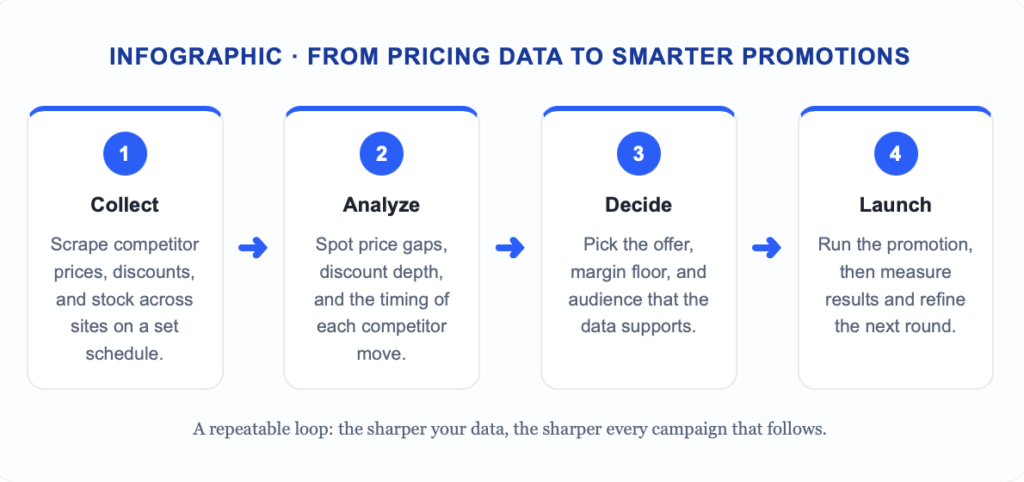
Automated competitor data extraction
Web scraping tools or custom data extraction solutions collect publicly available product information from competitor websites and online marketplaces. Depending on business requirements, extraction can run hourly, daily, or at scheduled intervals.
The collected information may include product names, prices, discounts, promotional offers, shipping charges, and stock availability.
Product matching and SKU identification
Before comparing prices, businesses must ensure that they are tracking identical products.
Product matching uses information such as SKU numbers, GTINs, brand names, model numbers, sizes, and product attributes. This prevents inaccurate comparisons between different product variants.
Data cleaning and normalization
Competitor information often comes in different formats. Prices may use different currencies, shipping costs may be displayed separately, and discounts may appear as coupon codes.
Data normalization standardizes these values so businesses can compare actual selling prices across different competitors.
Historical tracking and price alerts
Once processed, competitor pricing data can be stored to identify changes over time. Automated alerts notify teams when competitors reduce prices, introduce new discounts, or run promotional campaigns.
Marketing teams can use these insights to adjust promotional schedules, update product offers, and identify opportunities for targeted advertising.
A structured data pipeline helps businesses move from scattered competitor information to actionable pricing intelligence. With reliable, regularly updated data, marketing teams can focus on campaign decisions rather than manually collecting and organizing competitor prices.
How Frequently Should You Collect Competitor Pricing Data?
The frequency of competitor pricing data collection depends on product demand, competitor activity, industry trends, and promotional schedules. Collecting data too infrequently can cause businesses to miss important price changes, while excessively frequent collection may increase infrastructure costs without providing meaningful additional insights.
The following table provides a practical starting point:
Product category | Suggested refresh frequency | Reason |
Electronics | Hourly or several times daily | Frequent promotional and price changes |
Fashion and apparel | Daily or several times daily | Seasonal discounts and changing collections |
Grocery products | Multiple times daily | Frequent price and availability changes |
Home and furniture | Daily or weekly | Comparatively slower pricing changes |
Beauty and personal care | Daily | Promotional offers and competitive pricing |
Businesses should also increase monitoring frequency during major promotional periods such as Black Friday, Cyber Monday, Prime Day, and holiday sales.
For example, a retailer monitoring smartphone prices may need hourly updates during a major shopping event. The same retailer may find daily updates sufficient during a relatively stable sales period.
The objective is to maintain data freshness without collecting information more frequently than business decisions require.
How to Turn Competitor Pricing Signals into Effective Promotions
A signal only earns its keep when it maps to an action and a result. This table pairs common rival moves with a response and the business impact you can reasonably expect, so a decision takes minutes rather than a meeting.
Competitor price signal | What it usually means | Smart promotional move | Potential business impact |
Steady drop on a hero product | Market-share push or clearance | Targeted price-match or value bundle | Protects 3–6 points of gross margin vs. a blanket cut |
Deep discount, short window | Flash sale or seasonal event | Countdown deal with urgency messaging | Lifts urgency-driven conversions 10–20% |
Rival out of stock | Open demand gap | Full-price promotion plus paid search on the SKU | Captures demand at full margin; stronger ROAS |
Prices rising across a category | Cost pressure or firm demand | Modest increase plus a loyalty perk | Grows AOV while holding churn low |
Frequent coupon stacking | Fight on effective price | First-order code or free-shipping threshold | Improves effective-price competitiveness without cutting list price |
A Practical Example: Three Competitors Cut the Same Price
Picture a mid-size electronics store selling a wireless earbud at $79, with a hard margin floor of $68. On a Tuesday morning, three competitors drop the same model to $72, $74, and $75 inside the same hour, and the price alert fires within minutes.
Instead of racing to the bottom, the team checks the price history and sees that these rivals have reverted within 48 hours on the last four drops. Matching $72 would clear the shelf but crush margin to nearly zero. So, the plan takes a different shape:
- The counter-offer bundles the earbuds with a charging case at $82, framed as a $12 saving versus buying both separately, which keeps the blended margin healthy.
- The channel leans on paid search for the exact SKU, since rival stockouts and price churn leave that keyword wide open for 48 hours.
- The message states the bundle value plainly, with a 72-hour countdown that matches the rivals’ typical revert window.
Over the three-day run, the illustrative numbers tell the story: conversion rate climbs from 2.1% to 3.4%, average order value rises from $79 to $86, return on ad spend lands at 4.2x, promotional lift reaches 18% over baseline units, and gross margin holds near 31%. The store wins volume and protects profit, which a straight price match would never have done.
How Do You Measure Whether a Promotion Worked?
Collecting competitor pricing data and launching promotions are only part of the process. Businesses must also evaluate whether their campaigns generated meaningful improvements in sales and profitability.
The following metrics help marketing teams measure campaign effectiveness:
Conversion rate
Measures the percentage of website visitors who complete a purchase. Comparing conversion rates before and after a promotion helps determine whether the offer influenced buying decisions.
Average order value (AOV)
Shows how much customers spend per transaction. This metric is particularly useful when evaluating product bundles, minimum-order discounts, and free-shipping thresholds.
Gross profit margin
Helps determine whether a promotional campaign remains profitable after accounting for product costs and discounts.
Return on ad spend (ROAS)
Measures the revenue generated for every unit of advertising expenditure. It helps marketers understand whether competitor-informed advertising adjustments are delivering results.
Promotional sales lift
Compares sales during a promotional campaign against a suitable baseline. This helps distinguish genuine incremental demand from sales that would have happened anyway.
Competitor price position
Tracks how your product prices compare with competing offers before, during, and after a campaign. This helps determine whether your promotional positioning remains competitive.
Customer acquisition cost (CAC)
Measures the cost of acquiring a new customer. Businesses can use it to evaluate whether promotional discounts and paid advertising are attracting customers efficiently.
What Mistakes Should You Avoid?
Does chasing the lowest price always work?
A race to the bottom trains shoppers to wait for cuts and bleeds from both sides. Bundles, service, and loyalty usually earn steadier customers than the cheapest tag ever will.
Is stale data a real problem?
Old prices produce wrong calls, since popular products can be repriced several times a day. Fresh, scheduled tracking keeps your offers anchored to what buyers see this hour.
Should scraping ignore the rules?
Responsible collection respects site terms, public data, and sensible request limits. A clean, ethical pipeline protects your brand and keeps the feed running long-term.
Can Competitor Pricing Data Sharpen Your Ad Spend?
Paid budgets reward timing, and rival price moves are among the sharpest timing signals a marketer can read. When a competitor sells out or raises a price, their ad position on that product weakens, and that gap is where your spend stretches furthest.
- Bid timing: awareness of competitor stockouts supports higher bids on the exact SKU while demand has nowhere else to land.
- Budget focus: proof that your price beats the market justifies heavier spend on confirmed winners rather than hunches.
- Creative proof: a real price gap hands your ad copy a credible claim instead of a hollow “best deal” line.
Tie this back to ROAS, and the pattern is hard to Emily. Ads backed by live competitor pricing data convert at a lower cost per sale, because the offer and the moment finally line up.
Conclusion
Competitor pricing data gives e-commerce businesses a clearer understanding of market activity, helping them plan promotions, evaluate competitor offers, and make better advertising decisions. However, successful campaigns depend on more than identifying the lowest price. Accurate product matching, regularly updated information, historical price analysis, and campaign performance tracking all contribute to better promotional decisions.
For businesses monitoring multiple competitors and large product catalogs, automated data extraction can simplify the collection and organization of pricing information.
3i Data Scraping helps businesses collect competitor product and pricing information through web scraping and custom data extraction solutions. With structured data delivered for further analysis, marketing teams can spend less time gathering competitor information and more time planning effective campaigns.
Frequently Asked Questions (FAQs)
1. What is competitor pricing data in e-commerce?
Competitor pricing data is information about the prices, discounts, promotional offers, shipping charges, and product availability of competing retailers. E-commerce businesses use this data to understand market trends, evaluate pricing strategies, and plan more competitive promotions.
2. How can competitor pricing data improve e-commerce marketing campaigns?
Competitor pricing data helps marketers identify promotional opportunities, adjust campaign timing, target products with competitive advantages, and create relevant offers. It also supports better advertising decisions by highlighting competitor price changes, discounts, and stock availability.
3. How often should e-commerce businesses collect competitor pricing data?
The ideal collection frequency depends on product category, competitor activity, and market conditions. Electronics and grocery products may require hourly or multiple daily updates, while categories such as furniture may need daily or weekly monitoring. Businesses should increase tracking frequency during major sales events.
4. How can businesses use competitor pricing data without reducing profit margins?
Businesses can use competitor pricing insights to create value-based bundles, targeted discounts, loyalty offers, and free-shipping promotions instead of matching every price reduction. Monitoring historical prices and maintaining minimum margin thresholds also helps prevent unprofitable pricing decisions.
5. Which metrics should businesses track to measure competitor-informed promotions?
Businesses should monitor conversion rate, average order value (AOV), gross profit margin, return on ad spend (ROAS), promotional sales lift, competitor price position, and customer acquisition cost (CAC). These metrics help evaluate whether pricing-based campaigns improve sales while maintaining profitability.
6. How does automated competitor price tracking help e-commerce businesses?
Automated competitor price tracking collects and organizes pricing information from multiple websites at scheduled intervals. It helps businesses monitor price changes, identify promotional trends, receive alerts, and make faster marketing decisions without relying on manual data collection.
About the Author
3i Data Scraping Editorial Team
At 3i Data Scraping, our Editorial Team shares practical insights on web scraping, data extraction, and AI-powered data solutions. We create content based on industry trends and real-world applications to help businesses leverage web data for market intelligence, competitive analysis, and informed decision-making.