

Introduction
Today, e-commerce is one of the most competitive digital industries, with thousands of retailers and brands, marketplace owners, and marketplaces competing for customers’ attention. Retail prices fluctuate throughout the day and week, and new product listings appear daily, creating an ever-changing dynamic that heightens consumer expectations. Consequently, retailers must understand precisely what their competitors are selling and how their products are positioned to thrive in such a rapidly changing marketplace.
Matching products to identify those that are identical or similar in nature when listed on different sites is an essential strategy for succeeding in this competitive landscape. By automating product data extraction and enabling product matching, retailers can gain a competitive advantage. By building partnerships, manufacturers and distributors can access a wide range of product-related data. These types of data include: weekly price history, Manufacturer promotions, Future pricing predictions, and Research and analysis on MAP compliance.
Retailers have successfully developed an automatic product matching process that analyzes and compares various aspects of product characteristics, including title, description, and attributes, to increase revenue, decrease costs, and stay competitive in the e-commerce marketplace.
What Is Product Matching and Why Does It Matter in eCommerce?
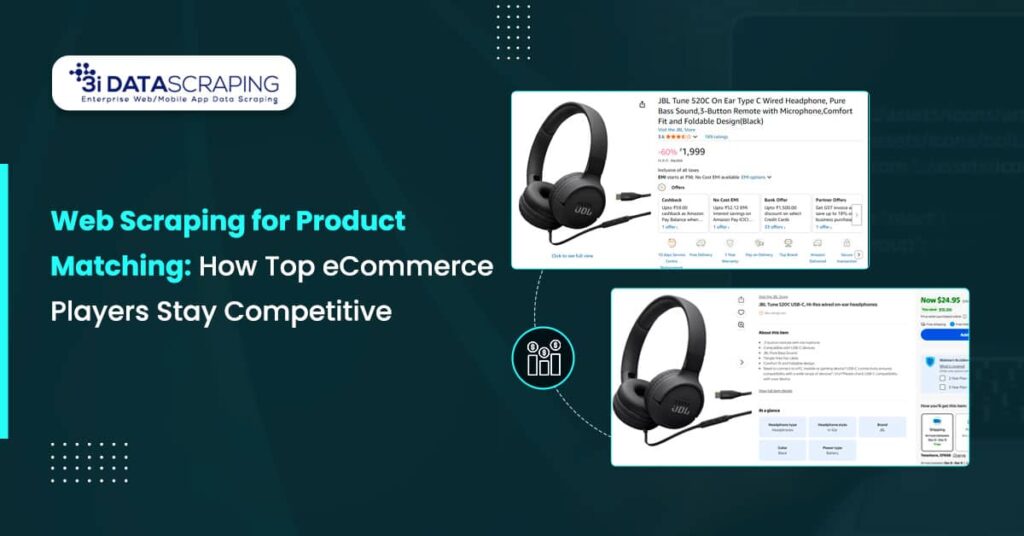
“Product Matching” is the process of finding identical products, even if they are listed under different names, sold in other ways, or offered by other retailers or e-commerce sites. Retailers lack a standardized way to showcase or sell their products, making it difficult to match items across sellers.
For instance, a consumer may find one retailer listing the product as “Sony WH-1000XM5 Noise Canceling Headphones,” while other lists it as “Sony XM5 Wireless ANC Headset.” Because of this, an automated system cannot accurately identify these products as the same product. Having a well-matched product-matching process is vital to achieving successful retailer sales because matching products enables retailers to compete on pricing, create successful product assortments, and maintain trust and confidence with their consumers. Having a correctly matched product catalog allows retailers to compare their catalog with a competitor’s; therefore, they can make timely changes to their pricing policies, identify products with untapped potential, and ensure they are selling a complete and accurate range of products.
Retailers can identify non-compliant resellers, take action against the sale of counterfeit goods, and enforce MAP (Minimum Advertised Price) policies through product-matching. Thus, product matching is a significant aspect of a retailer’s ability to maintain product integrity, operate effectively in e-commerce, and make more informed, strategic business decisions.
Why Do Retailers Rely on Web Scraping for Product Matching?
It creates the widest variety of the best, most reliable, and up-to-date datasets for comparing products between different teams and Chambers. Attempting to collect product data manually is not only time-consuming but can also allow for inaccuracies and cannot be accomplished on a timely basis for comparative purposes because it requires multiple manual sessions for multiple Sellers or for numerous SKUs, which would make it difficult to compare all competitors, and shoot for the front end of the Product Development Schedule.
Automated Web Scraping tools can also repeatedly retrieve product listings in Price, Product Name, Product Description, Images, and Current Stock Levels. Collectively, Automated Web Scraping tools allow you to see a real-time depiction of the ever-changing marketplace.
One of the main advantages of having a large dataset is the ability to make informed decisions about how to match products and make the most effective use of pricing differences that may exist between when the data is accessed and when the pricing is posted in the marketplace. It provides a wealth of insight into pricing strategies used by retail companies and how they initiate Pricing Corrections or introduce New Products into the market. A company that uses Web Scraping Data to implement Product Matching has a tremendous competitive advantage and greater marketplace visibility.
What Types of Data Are Most Important for Accurate Product Matching?
To effectively match products, you need to use multiple data types to get a complete picture of each product. The best source of structured product identifiers (e.g., UPC, EAN, GTIN, and MPN) is the one that provides the most accurate identification of a product across all retailers. In addition to that, many retailers do not include these identifiers on their websites, which means you will need to use other types of data in addition to structured identifiers.
In contrast to structured product identifiers, unstructured text (e.g., product titles and descriptions) provides context but can vary significantly across retailers. Natural language processing is required to determine the meaning of unstructured text. Images are also a critical component of product matching. In some product categories (for example, fashion), images are vital because they provide visual confirmation of the item’s accuracy. When product descriptions are unclear or inconsistent across retailers, image analysis enables automatic product matching.
In addition, the attributes (including size, color, weight, materials, capacity, and model year) will further differentiate your product variants. The complete data set, which includes all types of information, provides a clear view of the item. When the three elements mentioned above work together, the following will occur: automated product matching, elimination of gaps between retailers, and improved accuracy of product comparisons across many online retail stores.
How Do Top Ecommerce Brands Use Product Matching to Stay Competitive?
Leading eCommerce retailers are using product matching to develop insights into competitiveness, improve pricing, and optimize catalog expansion. The most helpful example of product matching is dynamic pricing, where matched products enable retailers to set prices in real time based on changing market conditions and competitive movements. Dynamic pricing ensures that retailers remain price-competitive while maximizing profitability.
Retailers can also use product matching to identify product assortment opportunities by finding trending products in a competitor’s assortment that are missing from their own. The data generated by product matching enables retailers to place more intentional purchase orders for their inventory and, in turn, expand their catalogs more rapidly. A brand’s ability to monitor integrity through MAP compliance, detect unauthorized sellers, and identify poorly priced listings that may damage its brand is also supported by product matching.
Additionally, marketplace operators can utilize product matching to improve catalog structures and eliminate duplicate listings. Improving how products match enhances customer experience by making searches more accurate. Product matching can also be a helpful tool. It helps with pricing and product selection, reduces the risk of damaging brand reputation, and boosts overall performance in the marketplace.
How Does Machine Learning Improve Product Matching Accuracy?
Machine Learning helps e-commerce sites make better matching decisions regardless of whether product data is complete, incomplete, consistent, or inconsistent. Traditional methods for product matching rely on preset criteria set by the site owner. Traditional matching will not return matches unless product titles match or contain identification numbers. Machine Learning (ML) methodology evaluates product data and can detect patterns in product names, descriptive phrases, etc. Machine Learning will analyse product similarity (in many cases) using several comparison methods rather than traditional approaches.
Machine Learning not only matches products based upon their titles, but also utilizes Natural Language Processing (NLP) to look for variations within product titles or descriptions (i.e., synonyms), to interpret the meaning of abbreviations used in product titles or descriptions, and to identify differences in the way products are described, grammatically speaking. Machine Learning’s ability to visually identify products is based on its ability to identify similarities between products by reviewing their visual attributes (visual patterns, shapes, colours, etc.) and determining potential matches, even when a product’s textual information is not known. The combination of scoring products based on attributes, metadata, and images provides a more thorough means to identify product similarities, creating a viable overall product match.
Hybrid Rule-based and Machine Learning approaches offer the most accurate results when removing apparent mismatches and performing complex evaluations. The nature of machine learning allows them to continue to refine their ability to match products over time. Retailers can use this to maintain an accurate level of product matching as their markets change.
How Do Web Scraping and Product Matching Work Together in a Real eCommerce Workflow?
Competitive intelligence is generated in real time with Web Scraping and Product Matching running in a continuous loop, starting with deciding which websites (major competitors, marketplaces, or brands) to monitor, then collecting their Product data at set intervals using automated web scraping tools. The scraped data consists of Product titles, Prices, Images, Specifications, Reviews, and Stock status.
Data normalization (cleaning and standardizing the data to remove inconsistencies) is followed by Product Matching Algorithms that analyze all attributes for similarities. Different methods can be used, including Rules, Scoring Systems, and Machine Learning. Once the matches are categorized as “Exact Matches,” “Close Matches,” or “No Match,” the results are published to Dashboards, Pricing Engines, or Business Intelligence Tools, where Trading Teams can see how competitors’ prices differ and what assortments are available. Many retailers have adopted a Product Matching process that triggers automatic repricing, inventory adjustments, and MAP enforcement alerts when an item is matched. This complete automation of the process enables retailers to make rapid, data-driven decisions and position themselves as competitive players in the market.
What Are the Biggest Challenges in Product Matching?
Many obstacles arise in product matching due to inconsistencies and unpredictability in e-commerce data. One major issue is that there are no universally defined names for eCommerce products; sellers frequently modify the wording of their product titles or add confusing terms, which diminishes the ability to use keyword searches to find similar items based on title.
In addition, sellers who fail to provide GTINs or UPCs create further difficulty in matching when numerous sellers offer generic versions of the same merchandise category (such as apparel).
Multiple variations also exist for some items: colours, size, pack quantity, etc. A minimal variance between two like items may produce false matches. Selling platforms and other third-party organizations may fail to include complete product descriptions for all products; as a result, it becomes challenging to identify product attributes from these descriptions. The speed of technological advancement is far greater than most sellers can keep up with in updating their product information. Sellers must also utilize scraping continually to obtain the most up-to-date product information. Anti-scraping tools are standard on most seller websites (e.g., CAPTCHA) and will further hinder scrapers’ ability to extract product data from sellers.
What Best Practices Should Businesses Follow When Implementing Product Matching?
Best practices in product matching include accurate matching across multiple dimensions, scalability to many products, and reliability, meaning the product matches can be used consistently over time.
First, companies need to obtain and use high-quality, up-to-date data; if the data is poor, it will result in poor product matching. Second, normalizing your data is critical: this means assigning a standard unit of measure to each attribute so that all attributes are comparable, removing special characters from attribute names, and providing a consistent name for each attribute across all product catalogs. A multidimensional approach to product matching typically combines identifiers, image similarity, text similarity, attribute comparison, and image comparison. Companies should regularly retrain their machine learning models to adapt to market and product catalog changes.
Furthermore, companies should employ humans to review products and ambiguous matches, especially when dealing with complex product categories (e.g., automobiles, luxury products, or appliances) for accuracy. Companies should use ethical and legal standards to conduct web scrapes (e.g., by following rate limit guidelines from the respective platforms) and utilize the matched items in pricing, BI, or everyday use to achieve the most outstanding value and gain a legitimate competitive advantage.
What Does the Future of Product Matching Look Like in eCommerce?
One area that will see significant advancements due to advances in AI is Product Matching. Multi-modal AI models will be created that leverage a combination of structured, text-based, and visual capabilities, along with their respective contexts, to significantly improve matching accuracy and overall performance. Future innovations in AI product matching will likely leverage consumer behavior signals (such as user clicks) and preference data to determine whether two products are functionally equivalent. It will provide retailers with real-time market intelligence through scraping engines rather than relying on periodic updates (e.g., hourly or daily).
Retailers will be able to utilize AI-driven predictive capabilities to analyse competitor pricing trends, forecast product launches, and identify product stockouts before they occur.
Additionally, with the prevalence of large language models (LLMs), retailers will have an opportunity to leverage Natural Language Processing capabilities and utilize various product data formats, including those with very complex/technical specifications.
Product-matching systems will therefore eventually become fully autonomous and require little to no human intervention while managing millions of stock-keeping units (SKUs). Improvements in product matching will allow retailers to operate more efficiently, make quicker decisions, and maintain their competitiveness in the ever-changing, more automated retail landscape.
Conclusion
The rise of e-commerce has created greater complexity for retailers and brand owners alike. For online retailers (e-commerce), web scraping is a vital tool for finding product matches across multiple retailers. Retailers & brands are using web scraping to collect data from various online retailers on the same product (price & inventory availability). Retailers/brands can monitor price changes as they occur throughout the day, optimize their full product range, ensure consumer compliance with branding, & make more informed business decisions based on properly collected market data.
With the introduction of various new technologies, including automated data collection methods, machine learning, & image recognition, matching products has been simplified & is far less challenging today than in the past. As a result, technology will enable retailers & brands to formulate more accurate market forecasts & become more efficient in running their businesses. Those brands that are currently investing in a high-quality product-matching solution will ultimately enjoy a significant competitive advantage as the e-commerce sector continues to evolve and grow exponentially.
About the author
3i Data Scraping
3i Data Scraping is a trusted web scraping services provider helping businesses turn web data into real, measurable growth. With hands-on experience across eCommerce, food, real estate, travel, finance, and on-demand industries, the team focuses on accuracy, compliance, and long-term reliability. Every project is backed by secure processes, strict quality checks, and ethical data practices. By delivering clean, structured, and actionable data at scale, 3i Data Scraping enables organizations to make smarter decisions and stay ahead in competitive markets.
