

Uber Eats Restaurant Data Scraping Services
The restaurant delivery market relies on quality data to track restaurant listings, menu prices, reviews and delivery patterns. 3i Data Scraping provides an Uber Eats data scraping service that collects structured data from the platform’s restaurant listings. This includes but is not limited to: restaurant location, menu items, menu prices, delivery charges, restaurant ratings and customer feedback information. Information gained can be utilized by a business to assess demand patterns of their restaurant, keep track of competitor activity, and adjust pricing and marketing strategy.
What Makes Our Data Scraping Solutions Reliable?
Data is essential for both restaurants as well as food delivery services to determine market trends in prices and consumer sales habits. 3i Data Scraping’s scrapers allow to directly collect structured data from the platform’s restaurant listings and menus. We are able to collect critical information including restaurant name, menu items, menu prices, delivery fee, rating and review, and type of cuisine.
By providing businesses with this structured dataset, they will have a comprehensive way to track their competitor listings and price comparison of all menu items across different locations. It helps recognize which menu items are “hot” or perhaps trending in a certain area or among specific customers. Our focus is on providing data through responsible and compliant means. Therefore, we only scrape publicly available data sources and perform stringent quality control checks. Providing businesses with accurate and reliable datasets from the platform’s allows for effective pricing strategy development, sales and marketing strategy design as well as valuable decision-making processes.
Scalable Data Extraction
Companies in the food delivery industry often need to collect large amounts of data to adequately analyze how well restaurants are performing. In order to assist with an assessment of restaurants operating via the platform, we provide clients access to quickly retrieve and gather data from Uber’s listings. Users will be able to access thousands of restaurants operating in multiple areas. This will allow users to monitor/track the menu items of their competitors and how pricing is being used by their competitors.
They will also be able to track which menu items are popular within the various geographical areas. All extracted information is provided in a format that makes it easy for users to analyze. All users, including food delivery service providers, restaurants, and market research groups, will be able to use the extracted information. It will assist in determining the appropriate pricing structure to ensure maximum profitability. It will also help to improve their menu offerings and to identify opportunities for participation in the growing food service delivery market.
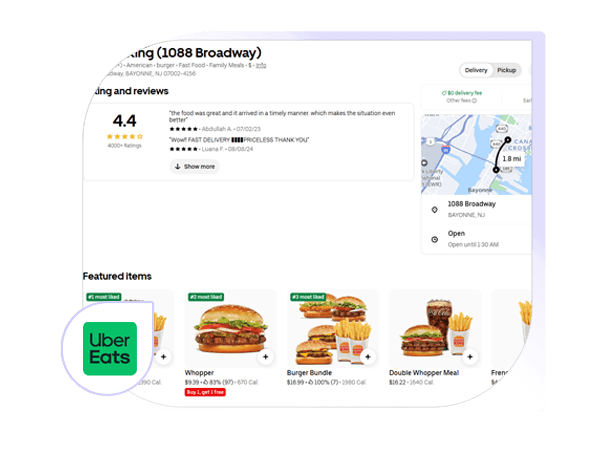
Gather Real-Time Uber Eats Data
Inventory and menu items from food delivery platforms change often. With each new restaurant added, there are changes in pricing and menu listings on a daily basis. To have a competitive edge over your competitors, you will need to collect updated and real-time information; therefore, you need our data scraping service.
3i Data Scraping’s data extraction services pull specific pieces of information about a restaurant such as its name, menu items, price, rating, review, delivery fee, estimated delivery time, and more. Having access to real-time data provides businesses with the ability to track the pricing and menu changes of their competitors as quickly as they happen. In addition, using our scraping service will allow businesses to track newly registered restaurants as well as popular menu items across multiple locations. The real-time data collected is completely structured, so it is easy to analyze.
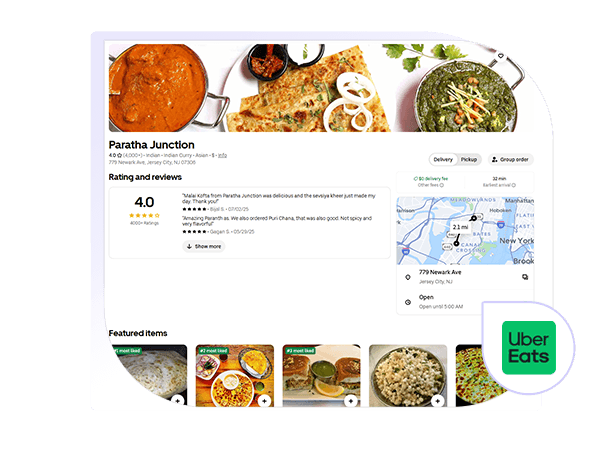
Leverage Uber Eats Data for Market Intelligence
Making smart decisions requires good data. All of these valuable insights about restaurant performance, menu prices, and customer preferences are available through the platform. With our data extraction services, businesses are able to compile the structured data that they require to analyze restaurant listings, menus, ratings, reviews, and delivery specifics.
Companies use the data not only to examine how their competitors are pricing their food across multiple markets but also to determine how customers are responding to different types of cuisines, how they are choosing to order, what dishes are getting the highest volume, and so on. Furthermore, restaurants can use this information to make adjustments to their menus; to improve their pricing strategies; to plan their promotional events; etc. As the data is preconstructed, the information obtained from the food delivery platforms and restaurants will make it easier for companies to make educated decisions regarding growth opportunities while remaining competitive in this very fast-paced food delivery market.
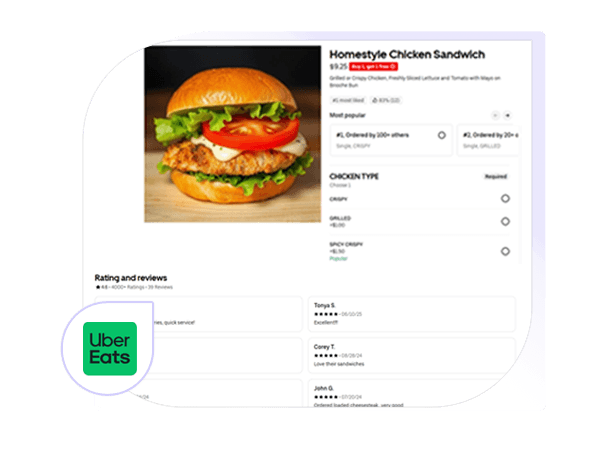
Uber Eats Data Fields We Extract
Food delivery is an important aspect of understanding both restaurant and customer needs. Therefore, collecting accurate food delivery data is important. Our data scraping services perform the extraction of structured data based on restaurants with the platform’s restaurant listings. The following are some of the key data fields that we can extract:
- Restaurant name
- Restaurant ID
- Type of cuisine
- Description of the restaurant
- Name of menu item
- Category of menu items (starters, entrees, desserts, etc.)
- Menu item price
- Discounts or promotions on menu items
- Restaurant rating
- Customer review
- Number of reviews
- Estimated time to deliver
- Delivery fees
- Minimum order amount
- Restaurant address (city, area, country)
- Delivery location
- Restaurant operating hours
- Restaurant open or closed
- Most popular menus
- Restaurant listing page URL
Use Cases of Uber Eats Data Scraping Services
Dynamic Menu Pricing Strategy
With insights extracted from the platform’s app, restaurants can check how other restaurants are priced in different locations. By analyzing competitors’ pricing, they can determine their own menu prices by maintaining both their market share and profit margins. Using a dynamic pricing structure to price items gives restaurants more flexibility in adapting to demand in the marketplace, seasonality, and competition.
Customer Preference Insights
Insights into what customers prefer can come from their reviews and ratings of meals. By analyzing the data, a restaurant can identify items that are considered high quality: taste, portions, delivery experience, and price. Then, the restaurant can use that data to enhance its dish quality, service, and what customers like most about dining at their restaurant to increase the overall satisfaction of customers and their likelihood of returning to the restaurant.
Market Expansion Planning
Restaurants can analyze the restaurant density, cuisine popularity, price patterns, and customer ratings of cities with an analytic tool to decide whether to enter a new market. Restaurants could choose to expand to these areas since they will have more assurance of success due to fewer risks associated with entering a high-demand, low-risk market.
Restaurant Performance Benchmarking
Evaluating performance against competitors can also be done by using the platform’s data. Stars and ratings, number of reviews, price, and menu diversity of competitors can be analyzed by restaurants using the given platform’s data to create a clearer picture of their position in the market. A restaurant can find areas to improve based on this evaluation and thereby increase their visibility and engagement with customers to improve overall performance.
Frequently Asked Questions
How can restaurants benefit from Uber Eats data scraping?
Data from the platform can help restaurants to gather information about comparable restaurants – like their menu options and pricing. This ultimately helps them price their options and decide what dishes have been the most popular among customers and which types of food are currently trending. Also, by using data to make informed decisions about their menu items, restaurants will likely see an increase in visibility to potential customers. And they will ultimately see improved performance from their restaurants overall.
Can Uber Eats data extraction help with competitor analysis?
By scraping the platform’s marketing data, businesses are able to track restaurants owned by their competitors at multiple locations. Companies can use the information they gather to compare pricing, menu items, ratings and reviews to determine where they may have an advantage. This will help them find gaps and new opportunities within the market that they can take advantage of. These insights generated through the scraping of the platform will allow food brands and restaurants to create better competitive menus. It will also help them adjust their pricing strategies and position themselves more effectively within the food delivery marketplace.
How frequently can Uber Eats data be updated?
Uber Eats can be scraped based on your business’s needs. The frequency can be either daily, weekly, or monthly. In order for businesses to keep up with any menu changes, price changes, new restaurant listings, or any customer reviews, they need to scrape the platform frequently to ensure that they are making their marketing, pricing, and expansion decisions based on current data.
In what formats is the scraped Uber Eats data delivered?
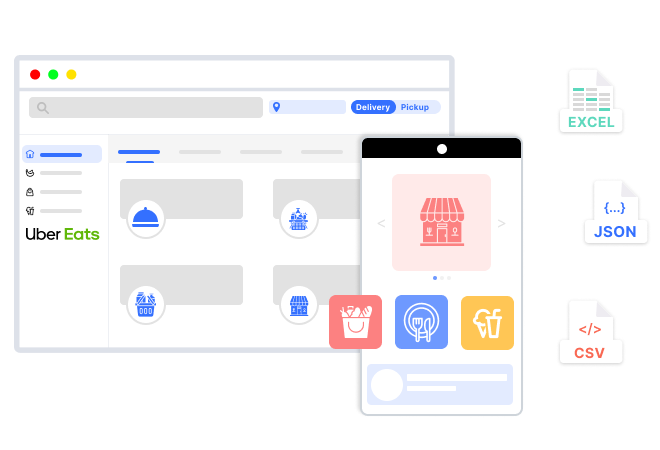
Typically, any data scraped from the platform comes in structured formats like CSV, Excel and/or JSON. These structured formats are then easily used for integrating with different analytics tools/business intelligence platforms/databases. Therefore, you can perform trend analysis and competitor analysis, pricing studies, etc ‖on structured data without the need of cleaning or processing.
Is Uber Eats data scraping customizable?
Absolutely! The data explained above can be scraped for your shop. That is, you can specify which data fields are important to your business. For example, menu prices, restaurant rating, delivery information and/or customer reviews. You also get to specify which city you want to scrape data for, which cuisine type, and/or what restaurant categories you wish to scrape. By customizing your extraction, you’ll be sure to receive only the data that is most relevant for your analysis or decision making.
Can small food businesses use Uber Eats data extraction?
Absolutely! Even smaller restaurants and food start-ups can benefit from the platform’s data extraction. By using the structured data about restaurants and their menus, these companies are able to compare pricing with other competitors, identify popular menu items, and collect information regarding customer experience. With the information collected from the given platforms, smaller companies can improve the quality of their menus, create price competition strategies, and ultimately compete in the ever-growing food delivery space.